If you’re in the wine business, you can’t really escape wine, even while on vacation. I wouldn't even want to really, but I’m often reluctant to tell strangers what I do for fear of what almost inevitably comes next: some variation on “Let me tell you about my experiences with wine…”
Showing posts with label Winemaker. Show all posts
Showing posts with label Winemaker. Show all posts
Wednesday, March 2, 2011

Friday, December 10, 2010
The Torturous Path
Hi there, blog fans.
I’m back from the fantasy world that we like to call the monthly Bulk Inventory Report, and I have to confess that I am thrilled to have the paperwork part of my job done for a few weeks. While it’s important to regularly keep an eye on volumes and the whereabouts of our wines, what this exercise really does is inspire a nearly rabid desire to get my hands dirty.
In truth, the extraordinary variability of this job is one great aspect of making wine for a living.
When I’m asked how I found winemaking as a career, I’m forced to sheepishly admit that I was that kid –the one who had no clear direction in life. Most of my friends knew by mid-way through high school that they wanted to be doctors or lawyers or teachers, but I was never sure. I liked elements of every job, but could never pick one path without fearing that I would feel trapped or that I would miss out on an integral part of who I should be. I kept thinking that surely by the time I was a senior, I would know what I wanted to do. I was wrong.
After high school, I spent a year in Belgium as an exchange student—plenty of time to figure out my future. Unfortunately, aside from realizing that the world is both bigger and smaller than I had ever imagined, and that I love to experience other cultures, cuisines, and languages, I had not come to any useful conclusions.
Enter college. Freshman year, I was a math/computer science major. I poured myself into AP Calculus, Pascal (it was a long time ago), and Number Theory. Sophomore year, I became an art major. Pause a second, and imagine that conversation. “Hi, Mom and Dad! Guess what? I dropped math, and I’m taking art.” Junior year, I transferred to a local college (no need to drive to Indiana to take art classes, dearie). By the second semester, I’d had enough art, and took off to France for a semester abroad (OK, so maybe they had a point). Senior year, panic set in. Still no reason to believe that I was meant to do anything in particular, yet I had a strong hunch that I was, and I couldn’t guess what that might be.
I didn’t think I had the patience and tenacity to teach (I was right—teaching is a gift, and I don’t have it). I couldn’t imagine crunching numbers inside an office for more than three consecutive days. Art was too fleeting—what if I lost my muse? Or worse—what if an art director wanted to change something in my work? I considered science, because I enjoyed that so much, but doing what? Biology and chemistry were fun, but I didn’t believe I’d find myself in a lab coat. I was fascinated by astronomy, but everyone, and I do mean everyone I told, said “No way—you can’t make a living watching stars, even if it is interesting.” Astronaut was out—I’m afraid of heights, and I’m claustrophobic.
Actually, I wasn’t claustrophobic until I went to Belgium. My class (teacher and all) took a senior trip via bus to Czechoslovakia. On our way home, we stopped in Germany to walk through a concentration camp. It was a holding camp rather than a death camp, and we were treated to the agonizing experience of being closed inside a holding cell. There were approximately 70 people crushed inside the cell, and I was toward the back of the crowd. Our guide explained that there was typically twice that number of people interred in these cells when the camp was in use. He looked in at us from outside the doorway and said, “There was no way to sit down, or lie down. People relieved themselves in place.” He gave us a moment to think about that, then concluded, “Many died and were held upright by the sheer number of bodies.” He swung the heavy door shut and locked it. The reality of 70 people in that cell was terrible. 140 people in that cell would be unimaginable. I clawed my way to the front of the crowd and pushed furiously and fruitlessly against the door. That moment will never leave me.
That experience made me a more considerate person. I’m careful to treat people well, because even on a small scale, it matters.
It also left me a high-functioning claustrophobe. I hadn’t fully ruled out astronaut until I returned from my year abroad, but it was definitely off the list.
So, there I found myself, well past the age when I was sure I would know what I wanted to do with my life, and I had still not found my way. With graduation looming in the all-too-near future, I had to force a decision. A perusal of my résumé and a visit to my advisor indicated that my major had to be French to graduate on time.
I finished up my Lit classes (17th, 18th, 19th, and 20th Century French Literature—loved every minute of it, not kidding), and was loosed upon the world.
By the time I had graduated from college I had collected a long list of things I didn’t want to be. I soothed myself by repeating over and over, “It’s OK. Finding out what you don’t want to do is nearly as good as figuring out what you do want to do.” Nearly being the key word, of course.
I knew I could make a living, because I liked so many things well enough, and I was lucky enough to be good at most of it. I ended up working in a bank—I really liked the idea of money, and my math, language and culture skills were sought-after by the international banking department.
Life unfolded, and my career, such as it was, gave way to motherhood. What a gift my girls are. What a gift staying home to raise them was.
In the course of things, I discovered wine, and eventually winemaking as a career possibility. It’s funny, I wasn’t even looking, and I found exactly what I was meant to do: raise these two girls, and make wine in the Finger Lakes.
August 2, 2005, Peter interviewed me for my first winemaking position (on the bottling line). He said “You can’t be claustrophobic, or afraid of heights.” I am not making this up. I told myself, “Well, I’m both, but for this job, I won’t be either.” And it hasn’t been a problem.
He also said, “You won’t make a fortune making wine, at least not in this part of the world. But,” he went on, “for those people who are truly passionate about making wine, job satisfaction is off the chart.”
Was he ever right!
I went from that kid, the one who couldn’t imagine doing anything for a lifetime, to that woman, that winemaker, who can’t imagine doing anything else.
Every day, I use math, and science, and art, and my creativity. I work alone some of the time, and in collaboration most of the time. The work can be physical and demanding or slow and even tedious at times (yes, bulk inventory, I’m invoking you). I pour my passion into the wines we make, as do Peter and Kelby.
I do a job I love, with people I admire wholeheartedly, for a company we are all so proud to say we belong to.
Sure, I took the long route, but it was the road that led me home.
Smiles From Above
 |
| The Chesire Cat has nothing on Tricia. |
By: Tricia Renshaw, Assistant Winemaker
Music of the Day:
- Tom Waits - Orphans; "Long Way Home":
Support Artists, buy the music you like!
Monday, December 6, 2010
Roll Out (Wash?) The Barrel
As I sit at home this evening looking at the beautiful snow falling outside, I can't help but be reminded of barrel washing. This feeling, strange as it seems, is even harder to avoid after having spent four hours wandering around the wilds of northern Wayne County searching for a Christmas Tree in the wind and snow earlier today. (Christmas Tree searching is a process which never ceases to amaze me for how long and complicated it manages to become for every additional person involved: there may be more platonic ideals for a "Christmas Tree" than there are for "wine.")
Why should associate cold and blowing snow with barrel washing and, other than the obvious, what exactly is the whole "barrel washing" thing about? Given the weather outside today, fortunately it has absolutely nothing to do with what is currently happening in the winery at Fox Run or this year... hopefully (*hint* *hint* Peter). Last year, however, when I first started working at Fox Run we were faced with a vintage and set of winemaking challenges quite distinct from 2010.
Rather than warmth and extraordinarily early ripening, and thus the early harvest we had this year, the 2009 harvest lasted much longer into the autumn. Where we had started to catch our breath this year around the beginning of November, to the extent that our red wines were already near or through fermentation, in 2009 we had just received the last blocks of red grapes around the beginning of November and didn't reach a relaxing moment until nearly Thanksgiving. With the 2009 red fermentations just completing around Thanksgiving, it meant that some of them were not ready to go into barrels until the beginning of December.
This is all well and good, but to get red wines into barrel at Fox Run - and most other wineries - means transferring (technically, racking) the red wines from the previous year that are in barrels to tanks. This frees up the barrel space, along with some new barrels every year, but the old barrels that have been emptied need to be thoroughly rinsed and cleaned before we put in the new wine. This basic step in sanitation is absolutely crucial, as there are spoilage organisms that can survive on the inside of a barrel and live on into the next filling. While there are some people who are proponents of the aromas these spoilage organisms create as "complexing," I'll leave that subject for Peter or Tricia to tee-off on another day. Suffice to say, we want our barrels clean.
To accomplish this, we have a rack that can be hauled outside to our crush-pad and setup so two barrels may be fork-lifted onto a cradle that suspends them off the ground and also allows them to be spun around so the bung hole can face downwards for draining. After the lees in the barrel have drained away to some extent, we insert an attachment into the barrel that connects to our pressure washer and excoriates the inside of the barrel with a powerful, rotating, spray of 170 degree water. Following a few minutes of this to (hopefully) sanitize the inside of the barrel, we turn off the burner and allow cold water to cool off and rinse the barrel before moving on and filling them again. All of this must be accomplished in relatively quick succession, from the emptying to the cleaning to the filling (certainly within a day) due to the sanitation concerns and, when two people are really on their game, we can empty/clean/fill around 30 barrels in a day.
The hitch comes with the cleaning portion, however; not only does it take the longest of any step in the process, it also has to be done outside. Last December, if those in the Finger Lakes and snow belt remember, was absolutely miserable. Exceedingly cold and snowy for this region, there was a period where the Rochester airport measured snowfall for 120 hours in a row. This would be bad enough on its own, but - as much as we love him - Peter seems to have a sixth sense for knowing when to plan on having someone else do something outside on the absolute worst weather day within seven days. It certainly isn't intentional, and is a strange phenomenon that the rest of us joke about, but last December it was as uncanny as it was brutal. Following a few days of nice weather we would have to do barrel work again, due to the late vintage, and this would inevitably be a day with driving wind, a sub-zero windchill, and pelting snow.
So as I look at my window at the foot of snow that has accumulated in under 2.5 hours (thin lake effect snow-band that setup over Newark), I am certainly moved by how beautiful it is. But I am also very glad to be inside and with our 2010 barrel work a month-old memory.
Winter pruning is a different story, but we'll make sure to have a guest blogger address that when it is appropriate!
By: Kelby Russell, Winemaking Team
Music of the Day:
Support Artists, buy the music you like!
Why should associate cold and blowing snow with barrel washing and, other than the obvious, what exactly is the whole "barrel washing" thing about? Given the weather outside today, fortunately it has absolutely nothing to do with what is currently happening in the winery at Fox Run or this year... hopefully (*hint* *hint* Peter). Last year, however, when I first started working at Fox Run we were faced with a vintage and set of winemaking challenges quite distinct from 2010.
Rather than warmth and extraordinarily early ripening, and thus the early harvest we had this year, the 2009 harvest lasted much longer into the autumn. Where we had started to catch our breath this year around the beginning of November, to the extent that our red wines were already near or through fermentation, in 2009 we had just received the last blocks of red grapes around the beginning of November and didn't reach a relaxing moment until nearly Thanksgiving. With the 2009 red fermentations just completing around Thanksgiving, it meant that some of them were not ready to go into barrels until the beginning of December.
This is all well and good, but to get red wines into barrel at Fox Run - and most other wineries - means transferring (technically, racking) the red wines from the previous year that are in barrels to tanks. This frees up the barrel space, along with some new barrels every year, but the old barrels that have been emptied need to be thoroughly rinsed and cleaned before we put in the new wine. This basic step in sanitation is absolutely crucial, as there are spoilage organisms that can survive on the inside of a barrel and live on into the next filling. While there are some people who are proponents of the aromas these spoilage organisms create as "complexing," I'll leave that subject for Peter or Tricia to tee-off on another day. Suffice to say, we want our barrels clean.
To accomplish this, we have a rack that can be hauled outside to our crush-pad and setup so two barrels may be fork-lifted onto a cradle that suspends them off the ground and also allows them to be spun around so the bung hole can face downwards for draining. After the lees in the barrel have drained away to some extent, we insert an attachment into the barrel that connects to our pressure washer and excoriates the inside of the barrel with a powerful, rotating, spray of 170 degree water. Following a few minutes of this to (hopefully) sanitize the inside of the barrel, we turn off the burner and allow cold water to cool off and rinse the barrel before moving on and filling them again. All of this must be accomplished in relatively quick succession, from the emptying to the cleaning to the filling (certainly within a day) due to the sanitation concerns and, when two people are really on their game, we can empty/clean/fill around 30 barrels in a day.
The hitch comes with the cleaning portion, however; not only does it take the longest of any step in the process, it also has to be done outside. Last December, if those in the Finger Lakes and snow belt remember, was absolutely miserable. Exceedingly cold and snowy for this region, there was a period where the Rochester airport measured snowfall for 120 hours in a row. This would be bad enough on its own, but - as much as we love him - Peter seems to have a sixth sense for knowing when to plan on having someone else do something outside on the absolute worst weather day within seven days. It certainly isn't intentional, and is a strange phenomenon that the rest of us joke about, but last December it was as uncanny as it was brutal. Following a few days of nice weather we would have to do barrel work again, due to the late vintage, and this would inevitably be a day with driving wind, a sub-zero windchill, and pelting snow.
So as I look at my window at the foot of snow that has accumulated in under 2.5 hours (thin lake effect snow-band that setup over Newark), I am certainly moved by how beautiful it is. But I am also very glad to be inside and with our 2010 barrel work a month-old memory.
Winter pruning is a different story, but we'll make sure to have a guest blogger address that when it is appropriate!
By: Kelby Russell, Winemaking Team
Music of the Day:
- Robyn - Body Talk; "Dancing On My Own" (Pop Song of the year from one of the most infectious and intelligent musicians out there. The fact she isn't famous or getting radio play with music like this, when Katy Perry or Lady Gaga are, is a musical crime.):
Friday, November 19, 2010
Autumn Repose
I hear it may snow tonight. I’m not really surprised—despite last week’s balmy weather, we are in the middle of November. We’ve lost our yellows and reds; the trees are skeletal, and everything is green or brown. The lake and sky are steely, and it is so still. It feels like snow.
At the winery, we’ve moved inside, and are tending to those homey things that get put off during the frenzy of vintage.
Kelby spent the morning scrubbing tanks. It turns out that Mr. Clean Magic Erasers are wonderful for shining stainless steel. Peter did some laboratory analysis, started a filtration, and answered e-mails. I vacuumed the warehouse- and winery-floors. None of it’s glamorous, but it’s essential.
Kelby’s roommate from his Harvard days, Dave, came to the winery today. He’s very friendly and has an easy smile. He fit right in here, and kept busy at the computer while Kelby finished his work. We all waited for a visit from our friends from Anthony Road.
Around 11:00, Johannes Reinhardt (winemaker) and Peter Becraft (assistant winemaker) came to review our wines with us. We gathered samples of all of our Rieslings, as well as our Pinot gris and Gewurztraminer.
We tasted and talked. We compared harvest figures (°Brix, pH, and titratable acidity) with those from Anthony Road. We made predictions about how our wines might develop: How will this Riesling taste when it’s reached dryness? Will the acid profile be just right when we blend these two Rieslings? After we filter this Riesling, will it show the clarity we’re after? Should Riesling 6 be released as a Reserve? We discussed flavors, and textures, and palate-weight. Johannes gave us his highest praise. “Elegant,” he quietly declared, as he sipped and nodded.
When we tasted our low-alcohol style Riesling, Johannes excused himself to fetch some samples from his winery, which is just down the road.
He returned with two fascinating bottles: one contained their low-alcohol Riesling. The other held a Riesling that they had allowed to spontaneously ferment (that’s to say, they did not add any yeast). They were made last year, and will not be released for a few years yet. These styles need time to develop into the beautiful and complex wines they will surely become.
Our small laboratory seemed a bright and cheery island in nature’s gray. It was warm, not only from all the bodies in our little space, but from the outpouring of enthusiasm and friendship.
It’s one o’clock, now. Johannes and Peter Becraft just slid away to attend to other tasks. Kelby and Dave packed into Kelby’s car; they’re off to visit old haunts in Boston. Peter is finishing up his filtration, and I, of course, am writing to you.
It occurs to me how the winery at this time of year is so much like many of our homes in late autumn. There is a lot of cleaning to be done, but it’s not all drudgery. The dreary days are often brightened by visits from friends we haven’t seen in a while. And it’s always nice to be puttering inside when it’s blustery outside.
Ask me in February how I feel about being indoors while gales are blowing, but for today, as geese are silhouetted against arctic clouds in a chrome sky, as pale-gold barren cornstalks wave about, as friends enjoy with us the bounty of our harvest, I am extraordinarily happy.
By: Tricia Renshaw, Assistant Winemaker
Music of the Day:
- Pink Martini - Sympathique; Sympathique:
Support Artists, buy the music you like!
Wednesday, November 17, 2010
Rackin' in the Free World
Mid November, and the winery crew is able to make it home for dinner, no sweat, every night, and take a bit of a break on weekends to boot. If I look back at the careful cellar records we keep for each wine we make, nicely done up in a binder specific to that year, I see that this has not always been so. Just a few years ago we were still pressing out a few bins of Cab franc in the week leading up to Thanksgiving, and yes, the snow was flying at the time.
The fruit flies I’ve written so fondly about in previous posts (did you know that fruit flies and people share 60% of their genes?) are doing their Custer’s Last Stand thing right now. Their redoubt in this case is not a bleak spot in the hills of Montana, but the winery lab; and they seem to know the game is up.
This week is a big one for racking. I should probably define that term here, and perhaps the best way to do that is to scroll through the Wiktionary entries on the verb ‘to rack’. We have:
The fruit flies I’ve written so fondly about in previous posts (did you know that fruit flies and people share 60% of their genes?) are doing their Custer’s Last Stand thing right now. Their redoubt in this case is not a bleak spot in the hills of Montana, but the winery lab; and they seem to know the game is up.
This week is a big one for racking. I should probably define that term here, and perhaps the best way to do that is to scroll through the Wiktionary entries on the verb ‘to rack’. We have:
- To Place in or hang on a rack
- Well, we do place our jackets on a rack most mornings, but that's not the definition we're after.
- (billiards, snooker, pool) To put the balls into the triangular rack and set them in place on the table.
- Sometimes we joke about getting a pool table up here, but that has yet to happen. Nope.
- (slang) To strike a male in the groin with the knee.
- Not gonna go there. I have been 'racked' once or twice in my life, but I didn't enjoy it enough to learn that there was actually a term for it.
- To stretch the joints of a person.
- I racked my brains trying to make this definition fit anything wine-related, and came up empty.
- To fly, as vapor or broken clouds.
- Obscure! Maybe someone had kneed the clouds in the groin. Fly away, little broken clouds!
- (brewing) To clarify, and thereby deter further fermentation of, beer, wine or cider by draining or siphoning it from the dregs.
At last! Here’s the definition we’re looking for, though in miserable sixth place, dictionary-wise. Our collective ego is bruised: Is what we do really less important than broken clouds? And what’s with calling lees ‘dregs’?
Anyway, picture a shiny tank of wine. Riesling inside. It has finished fermentation, and the yeasts – those beautiful microbes that do our bidding every fall (know what? we share a bunch of genes with them, too) are either still in suspension or sitting in a thick layer at the bottom of the tank.
It’s the ones at the bottom, the so-called heavy lees, that it’s time to say adios to. Here they are, in a picture taken moments before they were unceremoniously sluiced down the drain:
Anyway, picture a shiny tank of wine. Riesling inside. It has finished fermentation, and the yeasts – those beautiful microbes that do our bidding every fall (know what? we share a bunch of genes with them, too) are either still in suspension or sitting in a thick layer at the bottom of the tank.
It’s the ones at the bottom, the so-called heavy lees, that it’s time to say adios to. Here they are, in a picture taken moments before they were unceremoniously sluiced down the drain:
 |
| The sediment in a tank of wine at this time of year is composed mostly of dead or dying yeast cells. |
Their brethren and sistern, the light lees that are still in suspension, are not just pesky non-team-players in the wine clarification game. In fact, we want them there for a few more months, yea though they make the wine cloudy and gross looking. Some winemakers employ these dead and dying yeast cells to gradually add a little mouthfeel to their wines, in a process called autolysis. Others take advantage of their ability to scavenge oxygen from the wine, a really very useful talent if you think of a wine’s aging trajectory as being progressively more oxygen-averse.
By: Peter Bell, Winemaker
Music of the Day:
- Pearl Jam, covering Neil Young's Rockin' In The Free World at Pink Pop 92:
Support Artists, buy the music you like!
Friday, November 5, 2010
Aftermath: “And How Does That Make You Feel?”
Long ago I used to volunteer at a large annual music event in Toronto called the Mariposa Folk Festival. For folk music lovers – there seemed to be so many more of them back then – it was the highlight of the year, and attracted the likes of Bob Dylan, Gordon Lightfoot, Taj Mahal and Steve Goodman, along with performers in newly-rediscovered old genres like Zydeco, Old-Timey and even Clogging.
Support Artists, buy the music you like!
My tiny part in the planning and execution of this event involved making sure that performers got from the airport to their hotel and thence to the performance venue, and a few days later doing it all in reverse.
As soon as the last performer had been packed off to the airport late on Sunday afternoon, the festival was abruptly over for me. I was always struck with a “now what?” ennui for a few days afterward, a feeling that something really big and all-consuming had come and gone and now there was nothing to fill the void.
Not so with the phenomenon we have been blogging about so much lately, Vintage. Yes, vintage is over, but this is when the work begins. Work, that is, that feels more like normal winemaking and less like a concerted, giddy frenzy.
Here are some of the post-vintage tasks that are keeping us busy and engaged:
- Giving the crusher, must pump and press a final, thorough cleaning, and hanging up Son of Bertha, our trusty 4” must hose
- Inoculating about 80 barrels and tanks with the bacteria that will conduct the malolactic fermentation in the wines
Fourth Floor Walkup
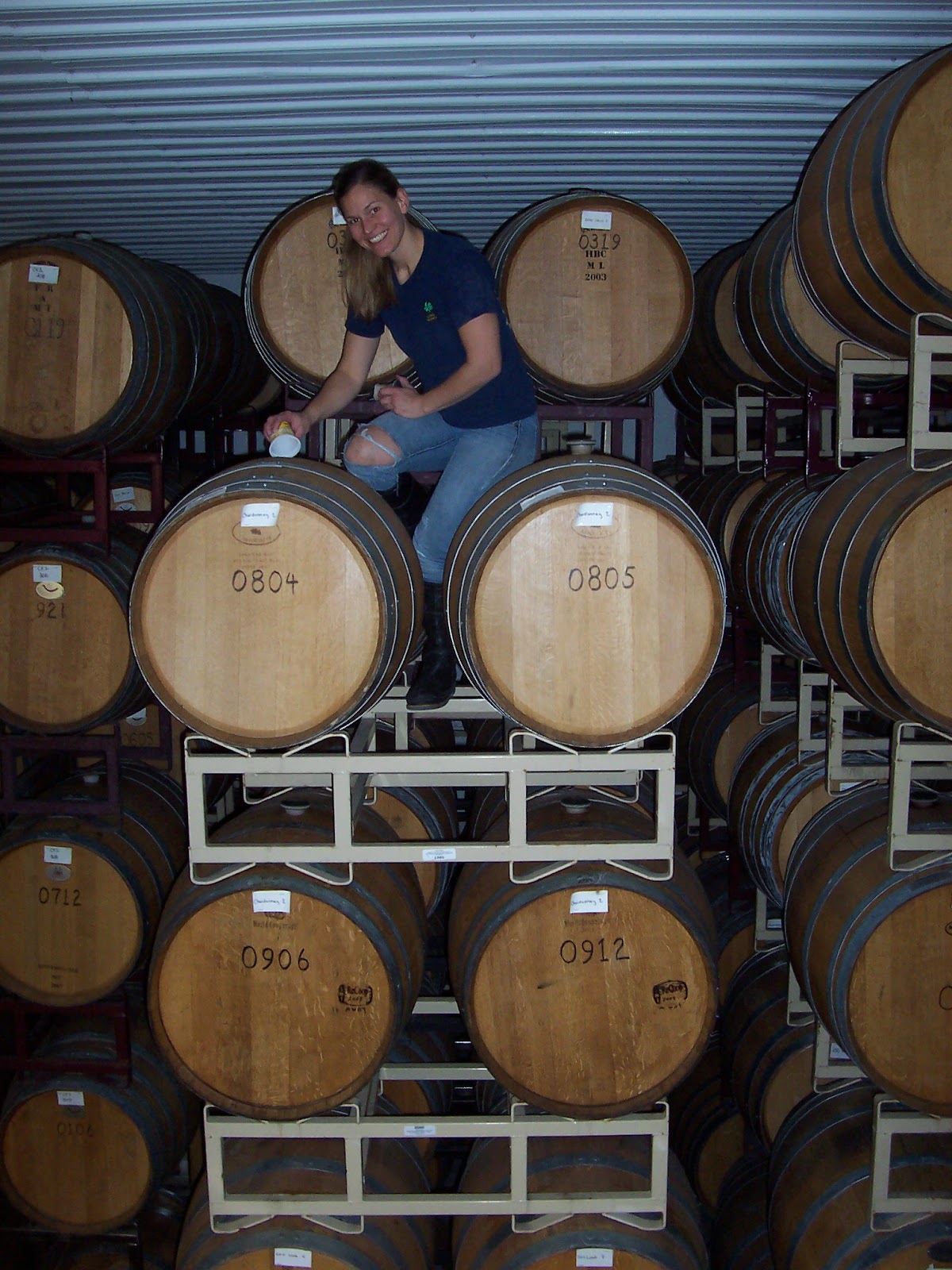 |
| Tricia adds freeze dried bacteria to a barrel of Chardonnay |
- Beginning the task of deciding which tanks of Riesling will play well with others, and introducing them to each other in a larger tank
- Vacuuming up the approximately 4 quadrillion fruit fly carcasses littering the lab
- Pumping last year’s red wines out of barrels and filling the barrels with this year’s reds
- Figuring out how we’re going to come up with the 400 cases of 2010 Arctic Fox wine that our marketing department needs in less than a month
- Trying to convince a defiant tank of Chardonnay to hurry up and ferment to dryness
- Tasting, spitting, tasting, spitting…
Overall it’s a thrilling time of year. No ennui to be found here.
By: Peter, Winemaker
Music of the Day:
- Iggy Pop - Brick by Brick; "Candy" (featuring Katy Pierson):
Support Artists, buy the music you like!
Monday, October 11, 2010
Riesling: Everybody Is a Star / I Love You For Who You Are
Almost all of our Riesling, fifty tons of it, has been harvested and is on its way to becoming wine. Previous posts have made mention of this grape’s ability to ramp up the excitement level in the winery. Riesling is our bread and butter (no reference here to the way it tastes), and the prospect of beginning another round of Riesling production makes us all giddy and joyous.
On our property, there are eight distinct plantings of Riesling on at least three soil types. As much as it would be convenient to bulk up the juice from these blocks into a couple of large tanks, doing so would eliminate, in one fell swoop, the possibility of making eight distinct tanks of wine. (Our largest format tank has attracted the nickname Bubba, but it might as well be called The Great Homogenizer. It tends to get used for things like Arctic Fox.)
Riesling, From Beginning To End
 |
| Four iterations of Riesling (left to right): Juice as it comes from the press, full of solids; juice after settling and racking; wine in its early stage of fermentation, showing cloudiness from yeast cells; finished wine after filtration. |
At the most basic level, we need to steer our Rieslings into two styles: Dry and Semi-Dry. Sales of the latter are generally about double those of the former. That alone means we have to have at least two production streams. But winemakers, inveterate tinkerers that we are, love experimenting with different yeast strains, different fining agents, different fermentation temperatures, and whatever else we think might add complexity and interest. Add those practices to the more obvious need to see what our different soils have been up to this year, and it’s easy to see why we end up with many small tanks of Riesling.
By: Peter Bell, Winemaker
Music of the Day:
Support Artists, buy the music you like!
Subscribe to:
Posts (Atom)