by Ben Peacock, President, Tousey Winery
Dieticians would say that you can tell a lot about a person from a peek inside their fridge. I would argue you can tell just as much from what's on the outside. For reasons unknown to me, people seem desperate to reveal and express themselves via the white and chrome vastness of this kitchen utility's outer surfaces. All of which are ready to be scanned and analyzed by covert fridge scanners like me. There's the snotty nose kid on a bicycle, the reminder of a dentist appointment and more often than not, a green takeout menu.
Showing posts with label Winemaking. Show all posts
Showing posts with label Winemaking. Show all posts
Thursday, July 28, 2011

Wednesday, July 6, 2011
July Reckoning
By: Kelby Russell, Winemaking Team Member
There is no denying it, we are definitely into the month of July. As much as we might like to close our eyes and pretend that it is still June, Independence Day is now behind us and the dog days of summer are beckoning. Don't get me wrong, we absolutely adore the glorious sunny days that summer in the Finger Lakes means - especially as those sunny days transform into molten twilights that seem to last forever. You will notice, however, that I did not employ the normal cliché of "carefree summer days," and that is precisely the point.
Our daily calendar for the month of July is a complete mess.
There is no denying it, we are definitely into the month of July. As much as we might like to close our eyes and pretend that it is still June, Independence Day is now behind us and the dog days of summer are beckoning. Don't get me wrong, we absolutely adore the glorious sunny days that summer in the Finger Lakes means - especially as those sunny days transform into molten twilights that seem to last forever. You will notice, however, that I did not employ the normal cliché of "carefree summer days," and that is precisely the point.
Our daily calendar for the month of July is a complete mess.
Friday, April 29, 2011
It's Tawny Time Again
by Peter Bell, Winemaker
It’s been quite some time since our last bottle of Fine Old Tawny was sold. This is one wine that can’t be made fast enough to meet the demand, and the 40 or so cases per year that we put out tend to get snapped up quickly. So this is what it must feel like to have your wines on allocation!
It’s been quite some time since our last bottle of Fine Old Tawny was sold. This is one wine that can’t be made fast enough to meet the demand, and the 40 or so cases per year that we put out tend to get snapped up quickly. So this is what it must feel like to have your wines on allocation!
Monday, April 18, 2011
What Can Modernist Cuisine Teach us About Wine?
By Peter Bell, Winemaker
If you’re serious about cutting-edge food and drink and happen to have $625 to spare, you might consider picking up a copy of “Modernist Cuisine: The Art and Science of Cooking”, just out in hardcover. I opted to save my money and read John Lanchester’s review in The New Yorker instead, since most of the food that the authors advance is best sampled in restaurants equipped with a few hundred thousand dollars’ worth of specialized cooking gizmos. Mind you, your meal at one of those places is likely to cost about the same as the book does, per person.
Monday, April 11, 2011
What I Learn From My Customers
By Dan Mitchell, Regional Sales Manager
I have been known during my time here at Fox Run to collect and archive some of the unusual comments and questions that come from visitors to our winery. These can come fast and furious when the tasting bar is five people deep. My responses are often of little help.
Friday, March 25, 2011
There's No Telling Who You're Going to Meet in New Jersey
by Lauren Brunhofer, PR intern
In college, there are two words that are very sacred to the average student: “Spring Break”. This week-long vacation is more than just a few days off from classes and academic responsibility. It is an opportunity to regain a sense of sanity after the seemingly endless duration of midterms. While some of us were lucky enough to venture off to a tropical oasis, I spent my Spring Break at home in everyone’s favorite state… New Jersey. Although I was unable to sip fruity drinks while sinking my toes into the sand, the weather was steadily above 50 degrees, which was paradise in comparison to the tundra of Geneva, NY.
In college, there are two words that are very sacred to the average student: “Spring Break”. This week-long vacation is more than just a few days off from classes and academic responsibility. It is an opportunity to regain a sense of sanity after the seemingly endless duration of midterms. While some of us were lucky enough to venture off to a tropical oasis, I spent my Spring Break at home in everyone’s favorite state… New Jersey. Although I was unable to sip fruity drinks while sinking my toes into the sand, the weather was steadily above 50 degrees, which was paradise in comparison to the tundra of Geneva, NY.
Monday, March 21, 2011
A Little Information Is A Dangerous Thing
by Dan Mitchell, Regional Sales Manager & Resident Wise Man
Wine questions can be tough to answer. For years I have harassed Peter for information and was sometimes frustrated when he would answer my question with "I can't tell you why". In retrospect he could tell me, of course he could, but what he was really saying was "the answer is so complicated you will only get confused with the answer". Agreed. I spent six years in the tasting room before making the transition to full time on the road. I answered a lot of questions myself in that time (with Peter's information) and learned a long time ago that the answer to most wine related questions is "It depends on the wine".
Wine questions can be tough to answer. For years I have harassed Peter for information and was sometimes frustrated when he would answer my question with "I can't tell you why". In retrospect he could tell me, of course he could, but what he was really saying was "the answer is so complicated you will only get confused with the answer". Agreed. I spent six years in the tasting room before making the transition to full time on the road. I answered a lot of questions myself in that time (with Peter's information) and learned a long time ago that the answer to most wine related questions is "It depends on the wine".
Wednesday, March 9, 2011
Understanding Wine in One Quick Lesson
by Peter Bell, Winemaker
Yesterday I drove over to Ithaca, New York, to teach a class at Cornell University. The lecture I gave, titled Balance in Wine, has been a regular of mine in that class for 17 years now. I often begin by telling the students (most of whom are not planning to become wine makers) that understanding this concept is probably the single most powerful tool for understanding wine.
Wednesday, February 23, 2011
It All Depends on How You Phrase Your Question
- by Peter Bell, winemaker
I love looking stuff up on Google, mostly so I can learn something new, but also once in awhile for pure entertainment. Often things occur to me in the middle of the night that merit researching the next day. Two mornings ago, my burning desire was to research, of all things, the esterification of tartaric acid and the effects of that transformation on wine taste. Please don’t give up reading this blog post, because I'm not going to talk about what I learned.
I love looking stuff up on Google, mostly so I can learn something new, but also once in awhile for pure entertainment. Often things occur to me in the middle of the night that merit researching the next day. Two mornings ago, my burning desire was to research, of all things, the esterification of tartaric acid and the effects of that transformation on wine taste. Please don’t give up reading this blog post, because I'm not going to talk about what I learned.
Because I’m not a good typist, I really appreciate Google’s ‘Suggest’ algorithm. It’s pretty good at anticipating one’s intentions and filling the search box with helpful shortcuts.
This morning, I asked Google to direct me to sites that would give hints on today’s winery task: topping barrels. In reality, I know all I need to know about barrel topping, after 23 years of winemaking, so I opted to have a little fun instead of divining hard facts. I decided to ask my question in two manners: Lowbrow and Highbrow.
Monday, February 14, 2011
Fighting an Enemy We Cannot See
So far as winemaking is concerned, our year can be broken down into two tasks. The first task is the creation and making of the wine, the incredibly intense and concentrated burst of work surrounding harvest and usually lasting until sometime around Christmas. The second task, which is no less important, might best be known "protecting" the wine. There is no mistaking that a lot of work goes into the wines to make adjustments or blend after the completion of fermentation, but there is also no denying that our role during this time of the year up until the wine is safely bottled is anything other than glorified stewardship.
Just as a shepherd must always worry about protecting their flock from the omnipresent danger of wolves, in the winery our primary concern is keeping the wine safe from a pervasive and invisible threat. This spoilage agent surrounds us, however, and in almost all other circumstances is necessary for life. I'm referring to oxygen, of course; O2, the eighth element, a molecule that makes up 20.946% of the earth's atmosphere by volume. You might think oxygen is something we would want to be on good terms with in the winery,* but the fact is that we spend nearly as much time restricting undesired oxygen contact with our wines as we do keeping things clean in the winery. That is a lot of time.
Just as a shepherd must always worry about protecting their flock from the omnipresent danger of wolves, in the winery our primary concern is keeping the wine safe from a pervasive and invisible threat. This spoilage agent surrounds us, however, and in almost all other circumstances is necessary for life. I'm referring to oxygen, of course; O2, the eighth element, a molecule that makes up 20.946% of the earth's atmosphere by volume. You might think oxygen is something we would want to be on good terms with in the winery,* but the fact is that we spend nearly as much time restricting undesired oxygen contact with our wines as we do keeping things clean in the winery. That is a lot of time.
Wednesday, February 2, 2011
Occupational Hazards, Winemaker Style
When I started working at Fox Run more than a decade and a half ago, I took up with a dentist whose office was closer to my new home. After getting my records sent up from my old dentist’s office, I went in for my first exam and cleaning.
Laura, the extremely chatty hygienist, hadn’t been poking around in my mouth for more than a minute or two when she suddenly went quiet and furrowed her brow. “What do you do?” she finally asked, in a way that made it clear she wasn’t just making small talk. “Eye-ay-er,” I answered, which was the best I could manage with a gloved hand and sharp pick in my mouth. She didn’t know what I was saying.
“I look at a lot of teeth,” she said, “but I’ve never seen ones like yours.”
“Uh ake ine.”
“What? Wait a minute while I finish.”
As she continued on her hygienic way, she elaborated. “I can look in peoples’ mouths and tell a lot about their lifestyle. I can tell if they’re heavy coffee drinkers. I can tell if they’re heavy tea drinkers. Pipe smokers have distinctive teeth. So do cigar smokers, pot smokers, tobacco chewers, tooth grinders, bulimics…”
“Bulimics?”
“The backs of their teeth are always badly eroded from contact with stomach acid. Anyway, you are none of the above. So what is it you do?”
“I put small quantities of wine in my mouth all day, hold them there, and then spit them out.”
There was a long pause.
“…..Excuse me?”
Laura told me that in addition to being badly stained, my teeth showed a distinct pattern of enamel erosion, especially at the gum line, which meant that major and costly repair work was in my near future.
“I don’t believe it…that’s what my horoscope said too!” I said, mouth agape.
She glanced down at my chart. “You Capricorns. Always with your superstitions!”
Laura asked me if there were any way I could use a machine to analyze the wines I was making, so as to give my pearly whites (actually they were spongy grays) a rest. I explained that while we do perform a number of lab analyses on our wines – pH, titratable acidity, residual sugar, alcohol content and the like – no apparatus existed that could tell if a wine smelled and tasted good. Hence the need to constantly put wine samples in our mouth, ponder them awhile, and then expectorate. (I didn’t tell Laura that my lab sink and drain bore the worst brunt of all, and needed the attention of a plumber every few years.)
Some time later I took a one-month sabbatical to teach at the University of Adelaide in Australia. One morning my horoscope told me that something momentous was going to happen that day, and sure enough, I happened upon an article in a trade journal titled “Winemakers, Look After Those Teeth!” The author was a dentist based in Canberra who had evidently had enough of whiny winemakers complaining that their choppers weren’t performing up to speed. He recommended using a recently developed product called Recaldent Tooth Mousse, which has the capacity to remineralize teeth and make them more resistant to acid attack.
The stuff is expensive and has to be shipped from Australia, but it really does work. I’ve told all my bulimic friends, who number in the thousands, about this product, as well as any winemaker who happens to complain of problems with tooth erosion.
And this morning I went in for my semiannual dental exam. Laura, the forensic dentistry expert, is long gone, but the staff there know that I am what’s called a Special Needs patient, and they indulge me accordingly. “Good for you!” they coo. “The staining is not that bad today! Good for you!”
By: Peter Bell, Winemaker
Music of the Day:
Laura, the extremely chatty hygienist, hadn’t been poking around in my mouth for more than a minute or two when she suddenly went quiet and furrowed her brow. “What do you do?” she finally asked, in a way that made it clear she wasn’t just making small talk. “Eye-ay-er,” I answered, which was the best I could manage with a gloved hand and sharp pick in my mouth. She didn’t know what I was saying.
“I look at a lot of teeth,” she said, “but I’ve never seen ones like yours.”
“Uh ake ine.”
“What? Wait a minute while I finish.”
As she continued on her hygienic way, she elaborated. “I can look in peoples’ mouths and tell a lot about their lifestyle. I can tell if they’re heavy coffee drinkers. I can tell if they’re heavy tea drinkers. Pipe smokers have distinctive teeth. So do cigar smokers, pot smokers, tobacco chewers, tooth grinders, bulimics…”
“Bulimics?”
“The backs of their teeth are always badly eroded from contact with stomach acid. Anyway, you are none of the above. So what is it you do?”
“I put small quantities of wine in my mouth all day, hold them there, and then spit them out.”
There was a long pause.
“…..Excuse me?”
Laura told me that in addition to being badly stained, my teeth showed a distinct pattern of enamel erosion, especially at the gum line, which meant that major and costly repair work was in my near future.
“I don’t believe it…that’s what my horoscope said too!” I said, mouth agape.
She glanced down at my chart. “You Capricorns. Always with your superstitions!”
Laura asked me if there were any way I could use a machine to analyze the wines I was making, so as to give my pearly whites (actually they were spongy grays) a rest. I explained that while we do perform a number of lab analyses on our wines – pH, titratable acidity, residual sugar, alcohol content and the like – no apparatus existed that could tell if a wine smelled and tasted good. Hence the need to constantly put wine samples in our mouth, ponder them awhile, and then expectorate. (I didn’t tell Laura that my lab sink and drain bore the worst brunt of all, and needed the attention of a plumber every few years.)
Some time later I took a one-month sabbatical to teach at the University of Adelaide in Australia. One morning my horoscope told me that something momentous was going to happen that day, and sure enough, I happened upon an article in a trade journal titled “Winemakers, Look After Those Teeth!” The author was a dentist based in Canberra who had evidently had enough of whiny winemakers complaining that their choppers weren’t performing up to speed. He recommended using a recently developed product called Recaldent Tooth Mousse, which has the capacity to remineralize teeth and make them more resistant to acid attack.
The stuff is expensive and has to be shipped from Australia, but it really does work. I’ve told all my bulimic friends, who number in the thousands, about this product, as well as any winemaker who happens to complain of problems with tooth erosion.
And this morning I went in for my semiannual dental exam. Laura, the forensic dentistry expert, is long gone, but the staff there know that I am what’s called a Special Needs patient, and they indulge me accordingly. “Good for you!” they coo. “The staining is not that bad today! Good for you!”
By: Peter Bell, Winemaker
Music of the Day:
- Dan Rooke; "Avenues of Forgiveness:"
Monday, January 24, 2011
The Lasting Concerns of Winemaking on the Edge
Full disclosure, I am not the person at Fox Run most qualified to speak about the following topic. That person would be John Kaiser, our fantastic vineyard manager, who I also hope will contribute some blog posts in the future about the crucially important and often publicly overlooked work he is responsible for. Nevertheless, the arctic air mass that settled over us this weekend and through tomorrow is what prompts the conversation and posting today.
By some accounts, the air over us and that radiational cooling last night represent the coldest temperatures this area has seen in five years or more. No doubt these are dangerous temperatures, it does not take more than a few minutes outside for exposed skin to be frostbit, but for most of us it would be an exaggeration to say that it is much more than an inconvenience. Here at Fox Run, however, we are talking about the weather and cold in far more serious terms - as is so often the case in an agricultural enterprise.
In the vineyard it is not just a question of how the low temperature will impact production for the 2011 vintage (a topic for another post entirely), but how the cold will immediately damage vines. The real concern with low temperatures like those we have been dealing with is vine death, as lost vines become a mounting issue when the temperature drops below -5 degrees Fahrenheit. Thus, where for most people this cold snap is bothersome for a few days and will be forgot with the next storm, in the vineyard temperatures this low are a serious concern into and beyond the spring.
Needless to say, we follow the forecast and temperature very closely this time of year when arctic air like this is descending on the region. After emailing Peter midweek about the low temperatures predicted for this past weekend, I asked the same question many of you are probably thinking, "Can anything be done?" The long and short of it is, frankly, no. In some densely planted wine regions of the world, they use fire pits or even helicopters during harvest time to change the temperature by a few degrees to stave off an early-frost. But when it comes to temperatures this cold, there is no real template and the heat would dissipate absurdly quickly. This is truly winemaking on the edge.
Here at Fox Run we are fortunate to have some snow that will act as insulation against the worst of the cold, and also have hope that the brief cold snap two weeks ago completely shut down the vines so they are less vulnerable now. Beyond this, however, Peter suggested praying to the deity of my choice as the only defense we have. So the next time you are at Fox Run or elsewhere around the Finger Lakes for a visit and to see vineyards, take a look at some of the areas that are unplanted and bare of vine. More likely than not, you're looking at a hollow where cold air gets trapped and settles during the nights.
By: Kelby Russell, Winemaking Team
Music of the Day:
By some accounts, the air over us and that radiational cooling last night represent the coldest temperatures this area has seen in five years or more. No doubt these are dangerous temperatures, it does not take more than a few minutes outside for exposed skin to be frostbit, but for most of us it would be an exaggeration to say that it is much more than an inconvenience. Here at Fox Run, however, we are talking about the weather and cold in far more serious terms - as is so often the case in an agricultural enterprise.
In the vineyard it is not just a question of how the low temperature will impact production for the 2011 vintage (a topic for another post entirely), but how the cold will immediately damage vines. The real concern with low temperatures like those we have been dealing with is vine death, as lost vines become a mounting issue when the temperature drops below -5 degrees Fahrenheit. Thus, where for most people this cold snap is bothersome for a few days and will be forgot with the next storm, in the vineyard temperatures this low are a serious concern into and beyond the spring.
Needless to say, we follow the forecast and temperature very closely this time of year when arctic air like this is descending on the region. After emailing Peter midweek about the low temperatures predicted for this past weekend, I asked the same question many of you are probably thinking, "Can anything be done?" The long and short of it is, frankly, no. In some densely planted wine regions of the world, they use fire pits or even helicopters during harvest time to change the temperature by a few degrees to stave off an early-frost. But when it comes to temperatures this cold, there is no real template and the heat would dissipate absurdly quickly. This is truly winemaking on the edge.
Here at Fox Run we are fortunate to have some snow that will act as insulation against the worst of the cold, and also have hope that the brief cold snap two weeks ago completely shut down the vines so they are less vulnerable now. Beyond this, however, Peter suggested praying to the deity of my choice as the only defense we have. So the next time you are at Fox Run or elsewhere around the Finger Lakes for a visit and to see vineyards, take a look at some of the areas that are unplanted and bare of vine. More likely than not, you're looking at a hollow where cold air gets trapped and settles during the nights.
By: Kelby Russell, Winemaking Team
Music of the Day:
- LCD Soundsystem - LCD Soundsystem; "Losing My Edge" (one of the most important, influential, and hilarious songs of the 00s for exposing the joys and troubles of the new music/information world the internet brought to listeners and hipsters):
Support Artists, buy the music you like!
Wednesday, January 12, 2011
But I Digress
The need to write a blog post every week or so has inspired me to troll through my haphazard collection of older books on wine, looking for amusing little sources of inspiration. These are mostly books written for the amateur wine enthusiast, which I was at one time, before I plunged into wine as a profession.
One title, published about 30 years ago, includes a very creditable section on what winemaking actually entails, in pictorial form. Titled “The Winegrower’s Year”, or something along those lines, it depicts an older mustachioed gentleman in a series of twelve hand-illustrated panels going thorough the putative cycle of his production year. The guy was certainly a polymath: not only did he make the wine, but he also appeared to do most of the vineyard work, as well as peddle his finished product to appreciative consumers and retailers.
Anyway, January’s picture showed him taking a well deserved break from his travails at a ski resort, presumably in the French or Swiss Alps, his long hand-knit scarf trailing him as he sped down the hill.
A more recent book, the fifth edition of The World Atlas of Wine, has a similar section, but the pictures have been updated, and now the jobs are divided among a number of different people, including women. No ski vacation either: January’s picture shows a warmly dressed fellow out in the vineyard pruning his dormant grapevines, while his counterpart in the winery is described as busily attending to her malolactic fermentations.
Here at Fox Run there continues to be plenty to do, though our tanks and barrels are asking very little of us in terms of intervention. Fermentations are long since finished. Winery staff do well to remember to wear warmer clothing these days, not because we’re outside pruning, but because the heat is turned way down in order to facilitate a process called cold stabilization. Tricia has promised to do an exposé on that subject in a future post, so I won’t talk more about it here (in fact, she tells me that it’s going to be a shocking exposé, so stay tuned).
This is also a fine time of year to pay visits to our fellow winemakers throughout the Finger Lakes, partly as a social gesture, but more importantly to taste their wines and see how they compare to our own. Recalibration of our sensory apparatus is a motivational factor too. Let me tell you: there are some stunning reds and whites out there from the 2010 vintage, led as usual by the illustrious and precocious Riesling.
You didn’t think I could get through an entire blog post without mentioning Riesling, did you? Even if I were composing a treatise on Current Trends in Shoe Polish, I would somehow find a way to work that grape into my narrative. And you must know by now that a near-religious worship of Riesling is not confined to our small band of fanatical winemakers either. Here’s a fragment from an article in a journal called The Riesling Report:
“What are your favorite grape varieties?” someone asked noted English wine critic Jancis Robinson during an on-line chat session a little over a year ago.
“Riesling”, she replied without hesitation.
“And your favorite blends of grapes?” added the persistent interviewer.
“Riesling and Riesling”, she shot back, as quick as a flash. “Riesling blended with Riesling would be pretty good.”
Jancis Robinson is someone whom I would call The Doyenne of Intelligent Wine Writing if I wanted to sound pretentious. (Pretentious? Moi?) She enjoys so much admiration among the winemaking staff here that we call her by her first name only, as if we were close friends:
“According to Jancis…”
“Let’s look it up in Jancis.”
“WWJS?”
Jancis knows the difference between ‘variety’ and ‘varietal’ as well as the true meanings of the words macroclimate, mesoclimate and microclimate. And she’s not afraid to insist with a gentle imperiousness that these words are not interchangeable. When the time comes for us to get on our soapbox about those terms, you will be hearing from her again.
By Peter Bell, Winemaker
Music of the Day:
- Gordon Lightfoot - The United Artists Collection; "Song For A Winter's Night":
Support Artists, buy the music you like!
Monday, December 6, 2010
Roll Out (Wash?) The Barrel
As I sit at home this evening looking at the beautiful snow falling outside, I can't help but be reminded of barrel washing. This feeling, strange as it seems, is even harder to avoid after having spent four hours wandering around the wilds of northern Wayne County searching for a Christmas Tree in the wind and snow earlier today. (Christmas Tree searching is a process which never ceases to amaze me for how long and complicated it manages to become for every additional person involved: there may be more platonic ideals for a "Christmas Tree" than there are for "wine.")
Why should associate cold and blowing snow with barrel washing and, other than the obvious, what exactly is the whole "barrel washing" thing about? Given the weather outside today, fortunately it has absolutely nothing to do with what is currently happening in the winery at Fox Run or this year... hopefully (*hint* *hint* Peter). Last year, however, when I first started working at Fox Run we were faced with a vintage and set of winemaking challenges quite distinct from 2010.
Rather than warmth and extraordinarily early ripening, and thus the early harvest we had this year, the 2009 harvest lasted much longer into the autumn. Where we had started to catch our breath this year around the beginning of November, to the extent that our red wines were already near or through fermentation, in 2009 we had just received the last blocks of red grapes around the beginning of November and didn't reach a relaxing moment until nearly Thanksgiving. With the 2009 red fermentations just completing around Thanksgiving, it meant that some of them were not ready to go into barrels until the beginning of December.
This is all well and good, but to get red wines into barrel at Fox Run - and most other wineries - means transferring (technically, racking) the red wines from the previous year that are in barrels to tanks. This frees up the barrel space, along with some new barrels every year, but the old barrels that have been emptied need to be thoroughly rinsed and cleaned before we put in the new wine. This basic step in sanitation is absolutely crucial, as there are spoilage organisms that can survive on the inside of a barrel and live on into the next filling. While there are some people who are proponents of the aromas these spoilage organisms create as "complexing," I'll leave that subject for Peter or Tricia to tee-off on another day. Suffice to say, we want our barrels clean.
To accomplish this, we have a rack that can be hauled outside to our crush-pad and setup so two barrels may be fork-lifted onto a cradle that suspends them off the ground and also allows them to be spun around so the bung hole can face downwards for draining. After the lees in the barrel have drained away to some extent, we insert an attachment into the barrel that connects to our pressure washer and excoriates the inside of the barrel with a powerful, rotating, spray of 170 degree water. Following a few minutes of this to (hopefully) sanitize the inside of the barrel, we turn off the burner and allow cold water to cool off and rinse the barrel before moving on and filling them again. All of this must be accomplished in relatively quick succession, from the emptying to the cleaning to the filling (certainly within a day) due to the sanitation concerns and, when two people are really on their game, we can empty/clean/fill around 30 barrels in a day.
The hitch comes with the cleaning portion, however; not only does it take the longest of any step in the process, it also has to be done outside. Last December, if those in the Finger Lakes and snow belt remember, was absolutely miserable. Exceedingly cold and snowy for this region, there was a period where the Rochester airport measured snowfall for 120 hours in a row. This would be bad enough on its own, but - as much as we love him - Peter seems to have a sixth sense for knowing when to plan on having someone else do something outside on the absolute worst weather day within seven days. It certainly isn't intentional, and is a strange phenomenon that the rest of us joke about, but last December it was as uncanny as it was brutal. Following a few days of nice weather we would have to do barrel work again, due to the late vintage, and this would inevitably be a day with driving wind, a sub-zero windchill, and pelting snow.
So as I look at my window at the foot of snow that has accumulated in under 2.5 hours (thin lake effect snow-band that setup over Newark), I am certainly moved by how beautiful it is. But I am also very glad to be inside and with our 2010 barrel work a month-old memory.
Winter pruning is a different story, but we'll make sure to have a guest blogger address that when it is appropriate!
By: Kelby Russell, Winemaking Team
Music of the Day:
Support Artists, buy the music you like!
Why should associate cold and blowing snow with barrel washing and, other than the obvious, what exactly is the whole "barrel washing" thing about? Given the weather outside today, fortunately it has absolutely nothing to do with what is currently happening in the winery at Fox Run or this year... hopefully (*hint* *hint* Peter). Last year, however, when I first started working at Fox Run we were faced with a vintage and set of winemaking challenges quite distinct from 2010.
Rather than warmth and extraordinarily early ripening, and thus the early harvest we had this year, the 2009 harvest lasted much longer into the autumn. Where we had started to catch our breath this year around the beginning of November, to the extent that our red wines were already near or through fermentation, in 2009 we had just received the last blocks of red grapes around the beginning of November and didn't reach a relaxing moment until nearly Thanksgiving. With the 2009 red fermentations just completing around Thanksgiving, it meant that some of them were not ready to go into barrels until the beginning of December.
This is all well and good, but to get red wines into barrel at Fox Run - and most other wineries - means transferring (technically, racking) the red wines from the previous year that are in barrels to tanks. This frees up the barrel space, along with some new barrels every year, but the old barrels that have been emptied need to be thoroughly rinsed and cleaned before we put in the new wine. This basic step in sanitation is absolutely crucial, as there are spoilage organisms that can survive on the inside of a barrel and live on into the next filling. While there are some people who are proponents of the aromas these spoilage organisms create as "complexing," I'll leave that subject for Peter or Tricia to tee-off on another day. Suffice to say, we want our barrels clean.
To accomplish this, we have a rack that can be hauled outside to our crush-pad and setup so two barrels may be fork-lifted onto a cradle that suspends them off the ground and also allows them to be spun around so the bung hole can face downwards for draining. After the lees in the barrel have drained away to some extent, we insert an attachment into the barrel that connects to our pressure washer and excoriates the inside of the barrel with a powerful, rotating, spray of 170 degree water. Following a few minutes of this to (hopefully) sanitize the inside of the barrel, we turn off the burner and allow cold water to cool off and rinse the barrel before moving on and filling them again. All of this must be accomplished in relatively quick succession, from the emptying to the cleaning to the filling (certainly within a day) due to the sanitation concerns and, when two people are really on their game, we can empty/clean/fill around 30 barrels in a day.
The hitch comes with the cleaning portion, however; not only does it take the longest of any step in the process, it also has to be done outside. Last December, if those in the Finger Lakes and snow belt remember, was absolutely miserable. Exceedingly cold and snowy for this region, there was a period where the Rochester airport measured snowfall for 120 hours in a row. This would be bad enough on its own, but - as much as we love him - Peter seems to have a sixth sense for knowing when to plan on having someone else do something outside on the absolute worst weather day within seven days. It certainly isn't intentional, and is a strange phenomenon that the rest of us joke about, but last December it was as uncanny as it was brutal. Following a few days of nice weather we would have to do barrel work again, due to the late vintage, and this would inevitably be a day with driving wind, a sub-zero windchill, and pelting snow.
So as I look at my window at the foot of snow that has accumulated in under 2.5 hours (thin lake effect snow-band that setup over Newark), I am certainly moved by how beautiful it is. But I am also very glad to be inside and with our 2010 barrel work a month-old memory.
Winter pruning is a different story, but we'll make sure to have a guest blogger address that when it is appropriate!
By: Kelby Russell, Winemaking Team
Music of the Day:
- Robyn - Body Talk; "Dancing On My Own" (Pop Song of the year from one of the most infectious and intelligent musicians out there. The fact she isn't famous or getting radio play with music like this, when Katy Perry or Lady Gaga are, is a musical crime.):
Monday, November 22, 2010
Where Have All The Fruit Flavors Gone?
With the fun and work of vintage behind us, now is the time that we have to have courage in our convictions at the winery. By this point in the year (i.e. three weeks after the completion of vintage) when we are asked a question regarding the 2010 vintage we almost resemble a high school debate team; ask about the Finger Lakes 2010 Harvest and we can tear off an answer from rote in record time. Ironically, it is precisely this time of year that we also happen to lose our ability to really track how our wines are doing.
This is not to say that our thoughts on Vintage 2010 are glib. Based on the available information, which we feel is only useful after all the grapes are in, we are happy to provide our estimation of how everything will look as these wines are released and opened. Nevertheless, in the winery we are now faced with an annual twist in winemaking that keeps us humble: the Thanksgiving slumber.
In her post on Gewürztraminer, Tricia briefly mentioned that one of the many times that leaves us doubtful in gewürztraminer’s development actually occurs after the harvest. The wine seems to go into a quiet funk, losing much of the lychee, rose, and fruit precociousness that made it so endearing mere weeks ago. What does it smell like it instead? Well, nothing, to be frank.
While we have seen this happen to our gewürztraminer already, it is a phenomenon that occurs with all of our aromatic white wines. Just as many of us will be doing after a large turkey dinner in a few days time, the rieslings, pinot gris, and gewürztraminer have all decided to take a snooze. These wines will not wake up from their nap for quite some time, however, and in the meantime will send us into fits in the winery wondering whether everything is all right.
This is where the courage part comes into the equation. During the fermentations of these wines we are constantly tasting everything and noting the beautiful aromas present in them at that stage. While this process is enjoyable, the primary purpose is to evaluate how the fermentation is progressing and ensuring nothing is compromising the wine. The other purpose of this tasting, however, is just as important; to get an early feel for what style of wine each block of grapes in each tank is best suited for.
Particularly as our rieslings are fermenting, when we taste we are taking note of the flavors in the wine and how they match up with its structure - especially the acid profile. With a softer and rounder riesling proto-wine, we start to think of our semi dry program and the slightly more tropical and tree fruit flavors we find complement that level of sugar. With a riesling that is lean and electric in its acidity, we lean more towards our dry program and the citrus driven flavors we appreciate with a lower level of sugar.
Based on this tasting we eventually decide when to end the fermentation of our individual blocks of grapes and thus how much sugar will be left in each. It is at this point that we then lose the guiding light of those beautiful flavors. By chilling the wine down to 28 degrees fahrenheit for a week and then adding sulfur, we arrest the fermentation and then kill the yeast. Trying to taste the wine at this point to find the flavors we hoped to lock into it is fruitless (your call whether it is the loss of fruit flavors or that terrible pun that is most unfortunate). To me, the wine smells and tastes flat even though the structure remains. Maybe there are hints of banana, but this aroma reminds me more of the suspended-solids character of a nice hefeweizen rather than the wine we wanted.
And with that we enter the winter, having to trust our decisions and our noses back when we decided to stop the fermentation. This trust gnaws away at us in the coming weeks as the continuing lack of fruit flavors begin to worry us, even though we know and expect this to happen. How was vintage 2010? It was fantastic, but right now we would appreciate it if some of those wines decided to agree.
By: Kelby Russell, Winemaking Team
Music of the Day:
- The Beatles - The Beatles ("The White Album" [Disc 2]); Good Night:
Support Artists, buy the music you like!
Friday, November 19, 2010
Autumn Repose
I hear it may snow tonight. I’m not really surprised—despite last week’s balmy weather, we are in the middle of November. We’ve lost our yellows and reds; the trees are skeletal, and everything is green or brown. The lake and sky are steely, and it is so still. It feels like snow.
At the winery, we’ve moved inside, and are tending to those homey things that get put off during the frenzy of vintage.
Kelby spent the morning scrubbing tanks. It turns out that Mr. Clean Magic Erasers are wonderful for shining stainless steel. Peter did some laboratory analysis, started a filtration, and answered e-mails. I vacuumed the warehouse- and winery-floors. None of it’s glamorous, but it’s essential.
Kelby’s roommate from his Harvard days, Dave, came to the winery today. He’s very friendly and has an easy smile. He fit right in here, and kept busy at the computer while Kelby finished his work. We all waited for a visit from our friends from Anthony Road.
Around 11:00, Johannes Reinhardt (winemaker) and Peter Becraft (assistant winemaker) came to review our wines with us. We gathered samples of all of our Rieslings, as well as our Pinot gris and Gewurztraminer.
We tasted and talked. We compared harvest figures (°Brix, pH, and titratable acidity) with those from Anthony Road. We made predictions about how our wines might develop: How will this Riesling taste when it’s reached dryness? Will the acid profile be just right when we blend these two Rieslings? After we filter this Riesling, will it show the clarity we’re after? Should Riesling 6 be released as a Reserve? We discussed flavors, and textures, and palate-weight. Johannes gave us his highest praise. “Elegant,” he quietly declared, as he sipped and nodded.
When we tasted our low-alcohol style Riesling, Johannes excused himself to fetch some samples from his winery, which is just down the road.
He returned with two fascinating bottles: one contained their low-alcohol Riesling. The other held a Riesling that they had allowed to spontaneously ferment (that’s to say, they did not add any yeast). They were made last year, and will not be released for a few years yet. These styles need time to develop into the beautiful and complex wines they will surely become.
Our small laboratory seemed a bright and cheery island in nature’s gray. It was warm, not only from all the bodies in our little space, but from the outpouring of enthusiasm and friendship.
It’s one o’clock, now. Johannes and Peter Becraft just slid away to attend to other tasks. Kelby and Dave packed into Kelby’s car; they’re off to visit old haunts in Boston. Peter is finishing up his filtration, and I, of course, am writing to you.
It occurs to me how the winery at this time of year is so much like many of our homes in late autumn. There is a lot of cleaning to be done, but it’s not all drudgery. The dreary days are often brightened by visits from friends we haven’t seen in a while. And it’s always nice to be puttering inside when it’s blustery outside.
Ask me in February how I feel about being indoors while gales are blowing, but for today, as geese are silhouetted against arctic clouds in a chrome sky, as pale-gold barren cornstalks wave about, as friends enjoy with us the bounty of our harvest, I am extraordinarily happy.
By: Tricia Renshaw, Assistant Winemaker
Music of the Day:
- Pink Martini - Sympathique; Sympathique:
Support Artists, buy the music you like!
Wednesday, November 17, 2010
Rackin' in the Free World
Mid November, and the winery crew is able to make it home for dinner, no sweat, every night, and take a bit of a break on weekends to boot. If I look back at the careful cellar records we keep for each wine we make, nicely done up in a binder specific to that year, I see that this has not always been so. Just a few years ago we were still pressing out a few bins of Cab franc in the week leading up to Thanksgiving, and yes, the snow was flying at the time.
The fruit flies I’ve written so fondly about in previous posts (did you know that fruit flies and people share 60% of their genes?) are doing their Custer’s Last Stand thing right now. Their redoubt in this case is not a bleak spot in the hills of Montana, but the winery lab; and they seem to know the game is up.
This week is a big one for racking. I should probably define that term here, and perhaps the best way to do that is to scroll through the Wiktionary entries on the verb ‘to rack’. We have:
The fruit flies I’ve written so fondly about in previous posts (did you know that fruit flies and people share 60% of their genes?) are doing their Custer’s Last Stand thing right now. Their redoubt in this case is not a bleak spot in the hills of Montana, but the winery lab; and they seem to know the game is up.
This week is a big one for racking. I should probably define that term here, and perhaps the best way to do that is to scroll through the Wiktionary entries on the verb ‘to rack’. We have:
- To Place in or hang on a rack
- Well, we do place our jackets on a rack most mornings, but that's not the definition we're after.
- (billiards, snooker, pool) To put the balls into the triangular rack and set them in place on the table.
- Sometimes we joke about getting a pool table up here, but that has yet to happen. Nope.
- (slang) To strike a male in the groin with the knee.
- Not gonna go there. I have been 'racked' once or twice in my life, but I didn't enjoy it enough to learn that there was actually a term for it.
- To stretch the joints of a person.
- I racked my brains trying to make this definition fit anything wine-related, and came up empty.
- To fly, as vapor or broken clouds.
- Obscure! Maybe someone had kneed the clouds in the groin. Fly away, little broken clouds!
- (brewing) To clarify, and thereby deter further fermentation of, beer, wine or cider by draining or siphoning it from the dregs.
At last! Here’s the definition we’re looking for, though in miserable sixth place, dictionary-wise. Our collective ego is bruised: Is what we do really less important than broken clouds? And what’s with calling lees ‘dregs’?
Anyway, picture a shiny tank of wine. Riesling inside. It has finished fermentation, and the yeasts – those beautiful microbes that do our bidding every fall (know what? we share a bunch of genes with them, too) are either still in suspension or sitting in a thick layer at the bottom of the tank.
It’s the ones at the bottom, the so-called heavy lees, that it’s time to say adios to. Here they are, in a picture taken moments before they were unceremoniously sluiced down the drain:
Anyway, picture a shiny tank of wine. Riesling inside. It has finished fermentation, and the yeasts – those beautiful microbes that do our bidding every fall (know what? we share a bunch of genes with them, too) are either still in suspension or sitting in a thick layer at the bottom of the tank.
It’s the ones at the bottom, the so-called heavy lees, that it’s time to say adios to. Here they are, in a picture taken moments before they were unceremoniously sluiced down the drain:
 |
| The sediment in a tank of wine at this time of year is composed mostly of dead or dying yeast cells. |
Their brethren and sistern, the light lees that are still in suspension, are not just pesky non-team-players in the wine clarification game. In fact, we want them there for a few more months, yea though they make the wine cloudy and gross looking. Some winemakers employ these dead and dying yeast cells to gradually add a little mouthfeel to their wines, in a process called autolysis. Others take advantage of their ability to scavenge oxygen from the wine, a really very useful talent if you think of a wine’s aging trajectory as being progressively more oxygen-averse.
By: Peter Bell, Winemaker
Music of the Day:
- Pearl Jam, covering Neil Young's Rockin' In The Free World at Pink Pop 92:
Support Artists, buy the music you like!
Monday, November 8, 2010
Socratic Dialogue Yields Quick Results
Last year, a good friend of ours, Evan Dawson, challenged the Finger Lakes wine community with a question: Why don’t we make a low-alcohol style Riesling like Germany does?
By: Tricia, Assistant Winemaker
Music of the Day:
Our responding question at the time seemed straightforward and air-tight: given that our Rieslings are beautifully balanced at around 11-12% alcohol; given that our cool climate blesses us with Rieslings which are nuanced and crisp; given their vibrant flavors that range from lime zest to mango purée to pineapple to tangerine; given that sometimes there are notes of fennel or bay leaf, and always some alluring river rock (who else can boast of river rocks?)…
Why would we want to copy a wine style from another part of the world, when our own Rieslings are so beguiling?
Fast-forward to last July, and you’d find Peter, Kelby and me at the Riesling Rendezvous in Seattle, Washington, a winemaker-heavy think tank devoted to this most singular grape variety. We, along with several other winemakers from the Finger Lakes, had the opportunity to taste hundreds of Rieslings from around the world. Over the course of three days, we participated in a slew of blind tastings and seminars, and came to some interesting conclusions.
First of all, you’ll be proud to know how well our local Rieslings showed among those from long-established Rock Star producers. Without knowing what they were tasting, the crowd -- comprised of Riesling producers from Alsace, Germany, Austria, Australia, Canada, New Zealand, and the US (both coasts as well as Michigan) -- extolled the enchanting flavors, beautiful acidity, purity and length of the Finger Lakes examples.
We weren’t at all surprised to rediscover how delicious our Rieslings are, but it was certainly nice to have our firmly-held beliefs reaffirmed in an international forum.
We were also not the least bit surprised to find some delicious, and different, expressions of Riesling being made around the world.
You might be surprised to learn that one of those styles was, yes, a low-alcohol sweet Riesling from Germany. What we admired in those examples was the balance achieved in a wine which should, by rights, taste like sugary juice. These wines had a lot, and I mean a lot, of sugar: around 60 to 70 grams per liter (or 6-7 percent, if that’s a more comfortable measurement for you). Their alcohol content ranged from 8-10 percent, and they achieved some delicacy, despite their fruit intensity. We were inspired.
We never want to stop making Rieslings in the styles Peter Bell has helped make internationally famous—very dry to semi-dry, with luscious flavors and clarity; perfectly balanced and with a moderate alcohol content (11-11.5 %). These wines are exquisitely poised as they go into the bottle in their youth, and they have consistently proven that they become even more delicious as they age. However, that doesn’t mean we don’t want to play with our boundaries.
At that conference, we surmised that our Finger Lakes fruit, given the right growing conditions, could produce a stunning wine in the low-alcohol style. As if by design, this summer provided what had to be ideal conditions. Lots of heat and sunlight produced grapes with a range of intense flavors—loads of lime and tangerine. We also had a good quantity of Botrytis, which presented as Noble Rot, concentrating the sugars and producing lovely marmalade aromas. We had high sugar accumulation, which meant we could ferment until we reached around 8% alcohol while still retaining quite a large quantity of sugar.
Of course, we had to take the plunge, albeit on a very small scale.
This past Friday, we stopped the fermentation on a few hundred gallons of low-alcohol Riesling by lowering its temperature below the comfort zone of yeasts. Boy, is it tasty! How it manages to taste like wine, despite having so little alcohol, is confounding but thrilling. It’s at once rich and delicate. It’s a Cool River of orange-fleshed aromas—papaya and mango and clementine -- with a lovely lashing of lime, which keeps the wine lively. Wait until you try it.
It won’t be a dead-ringer for German Riesling, but that’s a good thing. We always want our Rieslings to express their Finger Lakes character. The industry here is long past the point where we need to think of copying another region: our Rieslings have a sui generis standing that is acknowledged world-wide.
A few other wineries in the Finger Lakes are tinkering with this particular manifestation of old-world style winemaking, as well. Watch for these lower-alcohol wines, and let us know if you try any of them. We’d love to hear from you.
By: Tricia, Assistant Winemaker
Music of the Day:
- Kate and Anna McGarrigle - The McGarrigle Hour; Cool River (also featuring Lily Lanken and Martha Wainwright):
Support Artists, buy the music you like!
Friday, November 5, 2010
Aftermath: “And How Does That Make You Feel?”
Long ago I used to volunteer at a large annual music event in Toronto called the Mariposa Folk Festival. For folk music lovers – there seemed to be so many more of them back then – it was the highlight of the year, and attracted the likes of Bob Dylan, Gordon Lightfoot, Taj Mahal and Steve Goodman, along with performers in newly-rediscovered old genres like Zydeco, Old-Timey and even Clogging.
Support Artists, buy the music you like!
My tiny part in the planning and execution of this event involved making sure that performers got from the airport to their hotel and thence to the performance venue, and a few days later doing it all in reverse.
As soon as the last performer had been packed off to the airport late on Sunday afternoon, the festival was abruptly over for me. I was always struck with a “now what?” ennui for a few days afterward, a feeling that something really big and all-consuming had come and gone and now there was nothing to fill the void.
Not so with the phenomenon we have been blogging about so much lately, Vintage. Yes, vintage is over, but this is when the work begins. Work, that is, that feels more like normal winemaking and less like a concerted, giddy frenzy.
Here are some of the post-vintage tasks that are keeping us busy and engaged:
- Giving the crusher, must pump and press a final, thorough cleaning, and hanging up Son of Bertha, our trusty 4” must hose
- Inoculating about 80 barrels and tanks with the bacteria that will conduct the malolactic fermentation in the wines
Fourth Floor Walkup
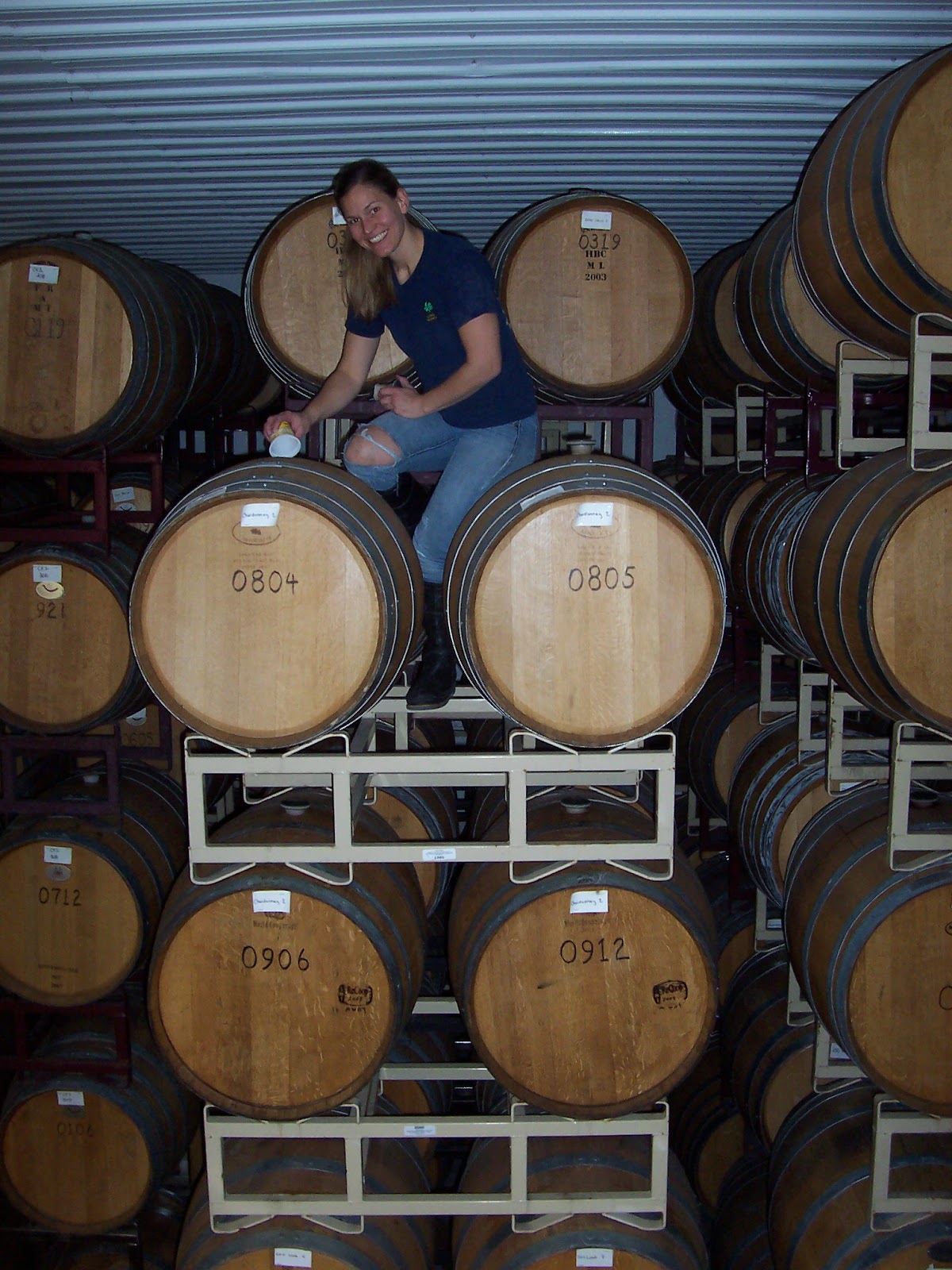 |
| Tricia adds freeze dried bacteria to a barrel of Chardonnay |
- Beginning the task of deciding which tanks of Riesling will play well with others, and introducing them to each other in a larger tank
- Vacuuming up the approximately 4 quadrillion fruit fly carcasses littering the lab
- Pumping last year’s red wines out of barrels and filling the barrels with this year’s reds
- Figuring out how we’re going to come up with the 400 cases of 2010 Arctic Fox wine that our marketing department needs in less than a month
- Trying to convince a defiant tank of Chardonnay to hurry up and ferment to dryness
- Tasting, spitting, tasting, spitting…
Overall it’s a thrilling time of year. No ennui to be found here.
By: Peter, Winemaker
Music of the Day:
- Iggy Pop - Brick by Brick; "Candy" (featuring Katy Pierson):
Support Artists, buy the music you like!
Wednesday, November 3, 2010
Reviewing Vintage 2010 (No Grades, New York Times Style)
2010 will go down as an unique growing season and vintage in the Finger Lakes. While our colleagues in California were dealing with difficulty ripening grapes (!), I remember calling my parents in early April as I was working in New Zealand - only to be told the temperatures were in the 80s. From a frighteningly early bud-break, given the threat of frost, to extremely warm and wet conditions throughout the summer, I do not think anyone has a clear idea of what this vintage will look like a few years from now.
Despite that, we have finished pressing out all our grapes now and I love to prognosticate. Based on what we are tasting and hearing from others around the lakes, here is a first stab at deciphering vintage 2010 now that we have enough information to try:
- Hybrid and Native Grape Wines (Cayuga, Concord, Niagara): This is a huge category to try and lump together, but the fact of the matter is that these grapes tend to ripen early and in the same timeframe. This vintage that meant we heard of people harvesting these grapes in early and mid-August at entirely normal sugar levels. Considering they came in so early, before the rain and storms that proved troublesome come September/October, it is a safe bet that 2010 wines made of these grapes will be just fine. Certainly the fruit was ripe, the only question that may vary from producer to producer is whether there was enough acid to back up the wine.
- Chardonnay and Pinot Noir: Both came in for most around Seneca Lake in early to mid-September, in that nice balmy stretch that finished out our summer. Dry skies and warm temperatures means that the harvest conditions were ideal, the warmth during the growing season resulted in some jaw-dropping sugar measurements on these two grapes. Never will the Finger Lakes turn into a producer of the bland, jammy, international style of red wine that some other New World pinot noir regions have traded on; but certainly this is a year for some of the richest fruit aromas and flavors we could hope for. Chardonnay were also rich and dense, so it looks like a great year across the region for wines made from either grape.
- Pinot Gris/Grigio and Gewürztraminer: Hard to summarize for these two Alsatian grapes, folks pulled them in at markedly different times across the region. At Fox Run we kept ours hanging for three weeks more than many down in the Seneca Lake Banana Belt were, but in the end I think everyone is happy with the ripeness of the grapes both in sugar and flavor. You’ve already heard Tricia’s take on our Gewürz, but I think the thing we were most amazed by was the fact that Pinot Gris grapes actually had distinct flavors. As popular a wine as it is, Pinot Gris grapes are not usually so striking in their aromatics and flavors. All in all, these were generally the last grapes to make it in before the series of rain events hit the Finger Lakes harvest and consistent high quality for 2010 seem likely.
- Riesling: There is never a bad year for riesling in the Finger Lakes, as Fox Run’s owner/president Scott Osborn often points out. 2010 is no exception, and has the potential to be a truly great year for the right growers and producers. By consensus, 2006 was one of the best years in recent memory for riesling in the Finger Lakes due to a nice balance of sugar with a clean acidity that did not disappear. The concern with 2010 is that the warmth and accumulated sugar levels would come at the expense of acid levels in the grapes and, subsequently, the grapes. So far that doesn’t appear to be a problem, and instead we are left with fantastically ripe fruit with tropical flavors we rarely attain. The bigger concern for 2010 riesling in the Finger Lakes will be variability due to harvest conditions. Riesling did not start being harvested until the brunt of the rain started to hit (as well as reports of ladybug outbreaks), leading to extreme disease pressure for growers that were not ready for the poor weather. Dreams of noble rot and late-harvest wines were shot by the reality of sour rot and disintegrating grape-skins forcing the hand of some growers to harvest everything and quickly. Having not had a chance to taste much, all we can say is a huge THANK YOU to John Kaiser and our vineyard team. Despite the rain, at Fox Run we had the luxury to pick our riesling when we felt they were ready - even leaving one special block hanging to pick up noble rot. John kept our fruit clean of disease and we are ecstatic with the 12 tanks of riesling now in our cellar.
- Bordeaux Reds (Cabernet Franc, Cabernet Sauvignon, Merlot): It is no secret that Finger Lakes reds can have a difficult time achieving ripeness levels we would consider ideal. Regardless of that, we can say something in general about the bordeaux reds of 2010 that would normally sound delusional; quality is likely as variable as with riesling. Great ripeness levels were almost a given this year for these grapes; high Brix levels, great flavor ripeness, even the seeds tasted densely chocolaty and nutty without a hint of bitterness. Unfortunately, due to how long they take to ripen, they had to survive the battering of cooler weather, rain, and wind that threatened later rieslings in October. We have high hopes for quite a few of our blocks, especially those we put into our Ruby Port and Tawny Port programs, but nothing firm will be known for another year when they start to come out of barrels.
2010 is not even fully in the books yet - and won’t be for quite some time if a winery is doing a late harvest or icewine - but there is a first attempt at summing up what we think we’re seeing. For the earlier ripening grapes 2010 looks to be fantastic across the Finger Lakes, for the later ripening grapes it comes down to knowing your producer. There will be nothing bad out there and the potential for greatness absolutely exists if a winery was able to seize it.
By: Kelby, Winemaking Team
Music of the Day:
- Thomas Tallis; Spem in Alium (as performed by the Tallis Scholars on The Tallis Scholars Sing Thomas Tallis):
Support Artists, buy the music you like!
Subscribe to:
Posts (Atom)